Spring is here — schedule your irrigation startup!

Sprinkler System Design for DFW Clay Soil —
What Actually Works

Standard spray heads put down water 4–7× faster than DFW clay can absorb it. Most of that water runs off into the street. Here’s how to design and program an irrigation system that matches your soil.

0.2–0.4″Clay absorption
per hour
1.5–2.0″Spray head output
per hour
4–7×Rate mismatch
(output vs. absorption)
~75%Runoff reduction
with cycle-and-soak

Your Sprinkler Applies Water Faster Than Clay Can Absorb It

This single mismatch is the root cause of runoff, water waste, and uneven coverage on every DFW clay lawn.

The Infiltration Rate Mismatch

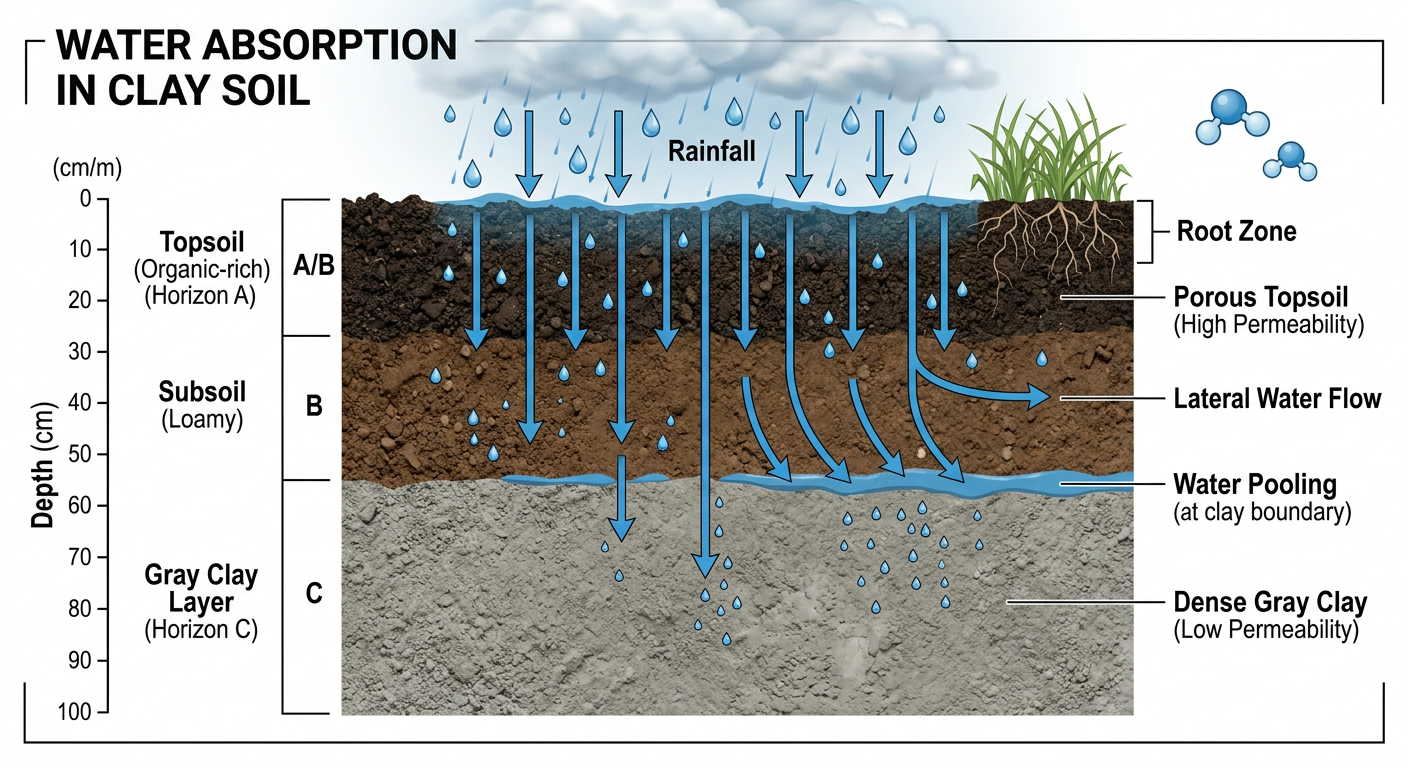
Compacted DFW clay absorbs water at roughly 0.1–0.3 inches per hour. A typical rotary sprinkler head applies water at 0.5–1.5 inches per hour, and standard fixed spray heads push out 1.5–2.0 inches per hour.

Within minutes of a zone starting, the soil’s surface is saturated. Everything above the infiltration rateThe speed at which water can move from the surface into the soil, measured in inches per hour. DFW compacted clay typically infiltrates 0.1–0.3 in/hr — far slower than standard sprinkler output. runs off — down the slope, across the sidewalk, into the street. You’re paying to water the storm drain.

The first cycle always infiltrates slowest because dry clay develops a slight surface water repellency. Subsequent cycles after a soak period absorb significantly faster as the surface re-wets.

The Math That Causes Runoff

Clay absorption rate0.2 in/hr
Spray head output1.5 in/hr
Mismatch7.5× too fast
30-minute run: applied0.75 in
30-minute run: absorbed0.10 in
Water wasted as runoff87%
Clay SoilSmall Pore Space • Capillary ActionDepth0"12"24"0"24"24"48"48"72"72"Elapsed: 0h1h2h4h8h16h24h48hWide horizontal spreadSandy SoilLarge Pore Space • Gravitational PullDepth0"12"24"0"12"12"24"24"Elapsed: 0h1h2h4h8h12h24hDeep verticalWatch water spread over time in each soil type

Cycle-and-Soak Programming

The correct technique for every DFW clay lawn. Several DFW municipalities mandate it.

Run a Short Cycle

Run each zone for 5–15 minutes — short enough that the applied water stays within the soil’s infiltration capacity. On most DFW clay, 8–10 minutes per cycle is the sweet spot for spray heads.

Let It Soak

Stop irrigation and wait 30–60 minutes. During this soak period, water that is sitting on the surface infiltrates into the root zone. The longer the soak, the deeper the penetration.

Run Again

Run the same zone for another 5–15 minute cycle. The second cycle absorbs faster than the first because the surface is already pre-wetted from the first pass.

Repeat Until Target Is Met

Continue cycling until you’ve applied the full volume needed. Two to three cycles is typical. Most smart controllers (Rachio, Hunter Hydrawise) have built-in cycle-and-soak features.

Worked Example: Typical DFW Clay Lawn

Goal: Apply 0.5″ of water to a zone with spray heads (1.5 in/hr output) on clay that infiltrates at 0.15 in/hr.

Single run approach: 20 minutes straight = 0.5″ applied, but only 0.05″ absorbed. 90% runs off.

Cycle-and-soak approach:

Cycle 17 min ON, then 45 min soak
Cycle 27 min ON, then 45 min soak
Cycle 36 min ON, done

Same 0.5″ applied, but each cycle allows absorption before the next begins. Most water reaches the root zone instead of the storm drain.

During the soak period, water moves downward through the soil under gravity and capillary tension. In clay, this infiltration front moves slowly — roughly 1–3 inches per hour depending on compaction. A 45–90 minute rest allows the surface water to fully infiltrate, creating capacity for the next cycle. Shorter rests (under 30 minutes) may leave surface water that simply compounds with the next cycle, recreating the runoff problem. Longer rests (90+ minutes) are appropriate for severely compacted clay where infiltration rates drop below 0.1 in/hr. The surface also transitions from hydrophobic (initially water-repellent when dry) to hydrophilic during the first soak, which is why the second and third cycles absorb faster.

Controller tip: On Rain Bird and Hunter controllers, set multiple start times for the same program to achieve cycle-and-soak. Rachio and Hunter Hydrawise have built-in smart cycle-and-soak that calculates rest periods automatically based on soil type.

Nozzle Selection for Heavy Clay

The nozzle determines how fast water hits the ground. Slower is better on clay.

Nozzle TypePrecipitation RateHow fast a sprinkler applies water to the ground, measured in inches per hour. Lower rates mean less runoff on clay.Wind ResistanceDFW Clay SuitabilityCost
MP RotatorHunter’s multi-stream rotary nozzle. Applies water in rotating streams at roughly one-third the rate of standard sprays, with better uniformity and wind resistance. (Hunter)0.4–0.7 in/hrHighBest choice$4–7 each
R-VAN (Rain Bird)0.4–0.8 in/hrHighExcellent$4–6 each
Standard Rotor0.4–1.0 in/hrMediumGood$6–12 each
Standard Fixed Spray1.5–2.0 in/hrLowCauses runoff$2–4 each
Drip Irrigation (beds)0.1–0.5 in/hrN/AIdeal for bedsVaries by run

Practical upgrade: Replacing standard spray nozzles with MP Rotators or R-VANs is the single most impactful equipment change for DFW clay. The nozzles fit existing spray bodies — no new trenching or piping required. Combined with cycle-and-soak programming, this typically reduces runoff by 70–80%.

Irrigation vs. Natural Compaction Recovery

Watering Suppresses Self-Healing

DFW’s Vertisol clay naturally fights compaction through dramatic shrink-swell cycles. When soil dries, deep cracks open new pore space. When it re-wets, expansion pushes compacted particles apart. Research shows five complete wet/dry cycles doubled water infiltration rates in compacted wheel tracks.

But year-round irrigation holds the soil in a moderate moisture range, suppressing these cycles. The soil never cracks deeply enough to create significant new pore space. This is a genuine tradeoff with no clean solution.

Signs You’re Overwatering Clay

Standing water more than one hour after irrigation stops. Earthworm corpses on the surface (driven out by anaerobic conditions). Perpetually spongy turf that never firms up. Soil that never dries also means no earthworm activity, anaerobic root conditions, and worse iron chlorosis.

See how overwatering worsens iron chlorosis →

When to Let It Dry

Consider allowing one deliberate dry-down in late October or early November before the season ends. Let the soil crack meaningfully — this is not damage, it is the soil’s natural recovery mechanism. The cracks create macropores that improve infiltration the following spring.

Managing the Tradeoff

Core aerate annually — Mechanically create the pore space that natural cycling would otherwise provide. Best timing: early fall when soil is moist but not saturated.

Encourage earthworm activity — Earthworm burrows create permanent macropores that survive shrink-swell cycles. Compost top-dressing feeds the population.

Allow a fall dry-down — Reduce irrigation in late October, let the soil crack before winter. The cracks self-heal when spring rains arrive, but the new pore geometry persists.

Monitor infiltration rate — A simple can-test each spring tells you whether your soil is improving or getting worse. If infiltration drops below 0.1 in/hr, prioritize aeration.

Common Irrigation Mistakes on DFW Clay

Most irrigation advice is written for sandy soils. On clay, much of it is counterproductive.

Running zones for 20–30 minutes straight

Cycle-and-soak: 3 × 7–10 min with 45 min soak

Long single runs exceed clay’s infiltration rate within minutes. Everything beyond that threshold is runoff. Breaking into cycles lets each application absorb before the next begins.

“Water deeply and infrequently” on compacted clay

Adequate surface moisture matched to root depth

Standard advice for sandy soils. In compacted DFW clay, roots are only 2–6 inches deep and water cannot infiltrate deeply enough to matter. Focus on the root zone, not an arbitrary depth target.

Keeping standard spray nozzles on clay

Switch to MP Rotators or R-VANs

Standard spray nozzles apply 1.5–2.0 in/hr. Clay absorbs 0.1–0.3 in/hr. Rotary nozzles apply 0.4–0.7 in/hr — close to the soil’s capacity. The nozzles drop into existing spray bodies with no new plumbing.

Watering in the heat of the day

Before 10am or after 6pm

Midday watering loses significant volume to evaporation before it ever reaches the soil. DFW municipal water restrictions also prohibit irrigation between 10am and 6pm during summer months. Early morning is ideal — low wind, low evaporation, and the lawn dries before nightfall (reducing fungal disease risk).

Same schedule for sun and shade zones

Shade zones need 30–50% less water

South-facing zones dry 2–3× faster than north-facing shaded zones in the same yard. Running the same schedule on both sides means the sunny side stays too dry while the shaded side stays waterlogged — creating exactly the kind of differential moisture that damages foundations and promotes disease. Separate controller programs for sun and shade zones, or use a smart controller with zone-specific adjustment.

Adding sand to clay to improve drainage

Aerate + compost top-dress annually

Unless you reach approximately 70% sand by volume throughout the profile, adding sand to clay creates a mixture with worse drainage than the original clay. Sand particles fill the existing pore spaces between clay aggregates, creating a dense, concrete-like matrix. The correct approach is core aeration to create macropores, combined with compost to feed biology that builds stable soil aggregates over time.

Irrigation Questions?

DFW clay makes irrigation harder than it should be. If your question isn’t here, call — Brandon programs and repairs systems on clay every day.

(469) 839-2113
What is cycle-and-soak irrigation?
Cycle-and-soak breaks each zone’s total watering time into short run cycles (5–15 minutes) separated by soak periods (30–60 minutes). Instead of running one zone for 30 minutes straight — where most water runs off clay — you run it for 10 minutes, let the water absorb, then run it again. Several DFW municipalities including Frisco mandate this approach.
Why does my sprinkler water run off into the street?
DFW clay absorbs water at only 0.1–0.3 inches per hour. Standard spray heads apply water at 1.5–2.0 inches per hour — 4 to 7 times faster than the soil can take it. Everything beyond the infiltration rate becomes runoff. The fix is either switching to low-precipitation nozzles (MP Rotators), using cycle-and-soak scheduling, or both.
How long should each sprinkler zone run on DFW clay?
Not as long as you think — but in multiple cycles. Each zone should run for 5–10 minutes per cycle, with 45–90 minutes of soak time between cycles. Two to three cycles per watering day is typical. This cycle-and-soak approach applies the same total water but gives clay time to absorb each application instead of sending it down the street.
What nozzles work best on clay soil?
MP Rotators (Hunter) and R-VAN nozzles (Rain Bird) are the best choices. They apply water at 0.4–0.7 inches per hour — roughly one-third the rate of standard spray nozzles. This slower rate stays within clay’s absorption capacity, dramatically reducing runoff. They fit existing spray bodies with no new plumbing required.
How do I program cycle-and-soak on my controller?
On Rain Bird and Hunter controllers, set multiple start times for the same program — for example, 5:00 AM, 6:30 AM, and 8:00 AM. Each start time runs all zones for a short cycle, with the gap between start times serving as the soak period. Rachio and Hunter Hydrawise have built-in smart cycle-and-soak features that calculate rest periods automatically based on your soil type setting.

Get Your System Optimized for Clay Soil

A licensed irrigator who understands DFW clay can reprogram your system, swap nozzles, and eliminate the runoff problem — usually in a single visit.