Clay soil irrigation · Dallas–Fort Worth
Clay Soil Irrigation Design for North Texas: Stop Runoff
Short answer
Your sprinklers put water down 5 to 15 times faster than DFW clay takes it in. Time the zone until water moves across the surface, then run cycles shorter than that with an hour of soak between.
An irrigation audit is how we do it for you, zone by zone, from measured numbers.
Brandon Surratt
TCEQ Licensed Irrigator
The one measurement
Find Your Runoff Point on Clay Soil
Every article on this subject tells you to split the zone into three cycles. Almost none tell you how to find the number that sets the cycle length. It is a measurement, not a recipe, and it takes one morning per zone type.
- 1
Run the zone and watch it
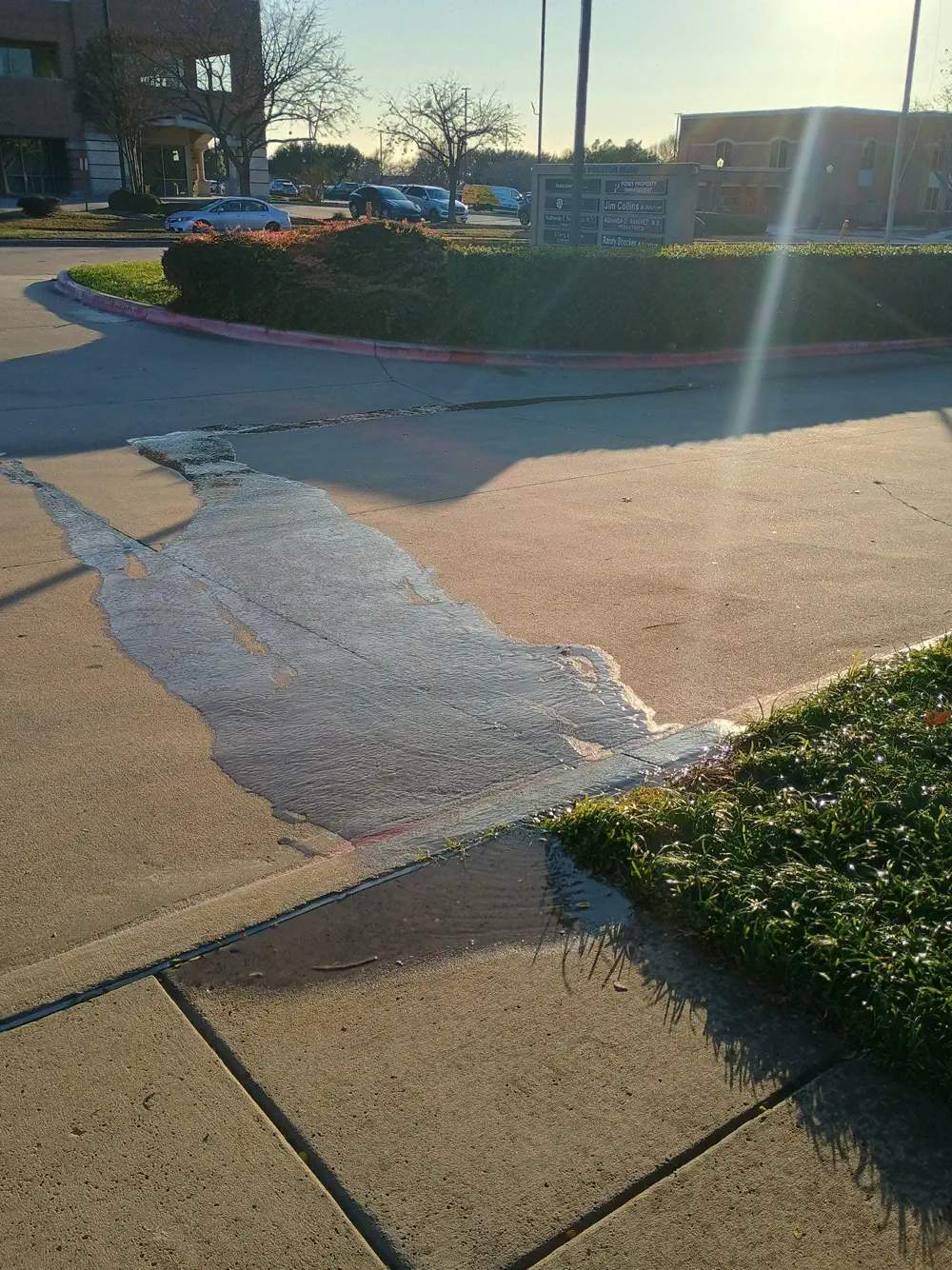
Stand there with your phone timer going. Note the minute water first starts puddling on the surface or moving across it. That minute is your runoff point. On a fixed spray zone on clay it is often only 5 to 8 minutes.
- 2
Set each cycle to about 80% of that time
If runoff starts at 8 minutes, run 6. Staying under the runoff point is the whole job.
- 3
Soak at least 60 minutes between cycles
Clay and slopes want the long end of anything you read.
- 4
Divide, don’t multiply
This is the mistake people make the day after they read an article like this one. Three cycles of your original run time triples your watering. Take the total you need and split it.
- 5
Verify the next day with a screwdriver
Push a long screwdriver into the soil. It should slide in easily 4 to 6 inches.
Texas A&M AgriLife calls for a minimum of 60 minutes between cycles on clay. The City of Frisco, citing AgriLife, uses moist to six to eight inches as the target, with cycles about an hour apart and no more than a six-minute run on a spray zone on 0.10 in/hr clay.
Before you touch the schedule
Runoff or a Leak on Clay Soil? Cycle One Tells You
A leak will still puddle during cycle one.
Clay that cannot take a 40-minute pass will take three short cycles without surfacing water. So if water stands in the same spot within the first few minutes of the first short cycle, you are looking at a leak, and the schedule will never fix it.
Two follow-up questions narrow it the rest of the way: does the wet area change while that station is running, and does it keep going after the clock moves on to the next zone?
Why it happens
The Precipitation Rate Mismatch on Clay Soil
Fixed spray heads apply water at 1.5 to 2.0 inches per hour. That is not our number, it is Hunter’s, from the tech note they publish for designers.
Your clay takes water in at 0.10 to 0.30 inches per hour if it is clay loam, and under 0.2 if it is true clay. Put those side by side and the mismatch is roughly 5 to 15 times.
The excess runs off down the driveway, into the street, toward the storm drains. Note where the nozzles land relative to the table: a multi-stream rotary nozzle at 0.4 to 0.6 in/hr is still faster than clay, but it is in the neighborhood. A fixed spray is not.
Most irrigation problems on clay soil aren’t about broken equipment. They’re about systems designed for loam or sandy soil trying to work on clay.
Soil intake rates by texture
Texture values, so treat them as order of magnitude rather than a measurement of your yard.
- Gravel / coarse sand
- Above 0.8
- Fine sand
- 0.50 to 0.75
- Sandy loam
- 0.40 to 0.80
- Fine sandy loam
- 0.35 to 0.50
- Silt loam
- 0.25 to 0.40
- Loam
- 0.20 to 0.40
- Clay loam
- 0.10 to 0.30
- Silty clay loam / clay
- Under 0.2
in/hr, from Cornell NRCCA and University of Maryland Extension. Most DFW suburbs sit in the bottom two rows — soil that runs 50 to 60% clay particles — and Texas A&M AgriLife puts infiltration on most urban Texas clay below one-tenth of an inch per hour.
Slow going in, but it holds: clay stores up to 1.70 inches of water in a 10-inch root zone (Clemson University), which is why a properly watered lawn on it carries 3 to 4 days in July heat.
The exception that is pure DFW
“Clay is slow” is true until August. Cracked clay with open fissures behaves differently from intact clay, because water runs straight down the cracks and past the root zone instead of wetting the soil above them.
The misread we hear all summer is that the cracks mean the lawn needs more water. Summer cracking is shrinkage. Turning the minutes up pushes more water down the cracks and more into the street. Why the soil behaves this way is on our DFW black clay soil page.
The rest of it, in one place each
Clay Soil Irrigation: Where Each Answer Lives
The 3 times rule (cycle and soak)
Split one long run into short cycles with soak time between them. The first cycle wets the top layer, the soak lets it move down, and the next cycle goes into primed soil instead of a sealed surface. Same total water, no runoff.
Best sprinkler heads for clay soil
Rotor heads and rotary nozzles, at 0.4 to 0.6 inches per hour against 1.5 to 2.0 for a fixed spray. That narrows the mismatch to something a schedule can work with. A spray head can still work on clay, but only with short run times.
Smart controller settings for clay soil
Set soil type to clay or heavy clay, set the slope, and set head type and sun exposure per zone. Enter clay as loam, which is the default on most controllers, and it runs single cycles far too long for the ground.
DFW seasonal watering schedule
Twice a week maximum for an established lawn, totalling about 1 to 1.5 inches including rainfall. Clay carries turf 3 to 4 days in July heat. Water between 5 AM and 10 AM. Run times taper month by month.
DFW black clay soil
Houston Black Vertisol is why any of this is true: montmorillonite clay that swells when wet, shrinks and cracks when dry, and holds water for days once it finally takes it in.
Soil testing and soil improvement
Core aeration once or twice a year, then topdress with 1/4 to 1/2 inch of compost. Never sand on its own: without enough organic matter it sets up closer to concrete. No amendment turns clay into loam.
Symptom, cause, fix
Troubleshooting Clay Soil Irrigation Problems
The five we hear about most often on sprinkler repair calls across Garland, Plano, Richardson and the wider DFW area.
| Symptom | Likely cause | Fix |
|---|---|---|
| Still runs into the street on cycle and soak | Cycles still longer than the soil’s intake rate | Cut cycles to 5 to 7 minutes, stretch the soak to 90 minutes or more, check for overpressure misting, consider rotary nozzles |
| Muddy underneath, dry on the surface | Hard crust over waterlogged soil: overwatering plus compaction | Screwdriver test. If it slides in 6 to 8 inches, water less often. Core aerate the crust |
| Dry patches while the rest is lush | Coverage gap, clogged head, a valve not opening fully, or high ground | Walk the zone while it runs. Check heads and the valve before touching the schedule |
| Standing water near the foundation | Heads watering the house, or grade draining toward the slab | Set the arc to 180° facing out, check the grade, then look at drainage |
| High water bill with the schedule dialed in | A buried leak, a run time that got changed, or a higher precipitation rate than you think | Audit for leaks, verify each zone’s actual minutes, run the tuna can test, add flow monitoring |
In Richardson and Plano, where many neighborhoods have significant slope on top of heavy clay, we have seen yards that need 5-minute cycles with 90-minute soaks to fully eliminate runoff. It feels counterintuitive. It works when the mismatch is that severe.
Clay Soil Irrigation FAQs
How fast does DFW clay soil actually absorb water?
What is the best sprinkler head type for clay soil?
How often should I water my lawn on clay soil?
What is the cycle-and-soak method?
Why does water run off my clay soil lawn?
How do I find the runoff point for a zone on clay?
Is my wet spot runoff or a leak?
How do I program my smart controller for clay soil?
Can I fix clay soil with sand?
When to Call a Professional About Clay Soil Irrigation
Most homeowners can do everything above themselves. Four situations are worth handing off:
- An irrigation audit —
- Runoff that survives everything on this page. An audit measures actual precipitation rate and uniformity per zone, which needs catch cups, moisture probes and pressure gauges.
- Valve locating —
- A valve you cannot find. Locating equipment finds a buried box without digging up the yard.
- Controller installation —
- Wiring, weather data and the per-zone clay settings all have to be right for the thing to help.
- Drainage —
- Standing water after you have fixed the schedule is drainage, not irrigation, and the first job is deciding whether it is surface or subsurface water.
If you just moved in and inherited the system with the house, start with bought a house with a sprinkler system and taking over the sprinkler system. Knowing what you have comes before tuning it.
Rather not work this out zone by zone?
An irrigation audit measures precipitation rate and distribution uniformity per zone, then we build the cycle-and-soak schedule from those numbers instead of a soil type guess.
References
- Hunter Industries, "Slope Irrigation," Technical Irrigation Notes (Fixed spray at 1.5 to 2.0 in/hr; precipitation rate should not exceed the soil’s intake rate; mid-slope heads tilted at half the slope angle.)
- Cornell University, NRCCA, "Soil Water Movement and Infiltration" (Soil intake rates by texture; cracked clay and macropore flow.)
- University of Maryland Extension, "Soil Infiltration Rates," publication C-3
- Texas A&M AgriLife Extension, "Cycle and Soak," AGEN-PU-218 (Minimum 60 minutes between cycles on clay; infiltration on most urban Texas clay well below 0.1 in/hr.)
- City of Frisco, "Cycle and Soak" (Local clay about 0.10 in/hr; no more than a six-minute spray run; cycles about an hour apart; moist to six to eight inches.)
- Clemson University Home & Garden Information Center (Soil water-holding capacity for clay-textured soils.)
This information is provided for educational purposes. Some irrigation repairs and system modifications may require knowledge of local plumbing codes or specialized equipment. If you’re unsure about any repair or installation, contact a licensed irrigation professional in your area.
Better Earth Solutions serves the DFW Metroplex including Garland, Plano, Richardson, Rowlett, Wylie, Murphy, Allen, Dallas, Rockwall, Heath, Lucas, Lake Highlands, Casa View, Preston Hollow, and Willow Bend. For irrigation repair, installation, or smart controller setup, call (469) 209-4110 or book online.
Brandon Surratt
Better Earth Solutions
- TCEQ Licensed Irrigator LI0023963
- Texas Certified Landscape Irrigation Auditor (TxCLIA)
- Rachio Expert
Last updated: