The generic national averages you find online don’t reflect what repairs actually cost in DFW. Every other irrigation company says “call for a quote.” This guide breaks down what each type of sprinkler repair actually costs, what makes the price go up or down, and how to avoid getting burned by unlicensed operators using cheap parts.
What you’ll learn:
- Flat-rate pricing for every common sprinkler repair in DFW
- What drives costs up — and what doesn’t
- When to DIY vs. when you need a licensed irrigator
- Why the cheapest quote can cost you more in the long run
- What a 3-year warranty actually covers
Experience level: All homeowners
- Most DFW service calls fall in the $250–$600 range, quoted flat-rate before work starts
- Pipe repair is the cheapest fix at $127; valve repair starts at $150; head replacement starts at $55
- DFW clay soil, tree roots, and buried valves are the biggest cost drivers
- Controller programming is free with any inspection or repair visit
- Every repair includes a 3-year warranty on parts and labor
What Sprinkler Repairs Actually Cost in DFW
Every repair is quoted flat-rate before work begins. You get a specific dollar amount — no running clock, no surprise line items. If something changes once we’re in the ground, you get a revised estimate and decide how to proceed.
Most service calls fall in the $250 to $600 range depending on what’s going on with your system. Here’s what each type of repair costs and what makes the price go up or down.
Pop-up sprays, rotors, and specialty nozzles. Price depends on head type and accessibility. Heads buried under sod or on rigid risers cost more.
Learn moreSolenoid replacement, diaphragm swaps, wiring fixes. Roots, corroded wiring, and buried valves that need locating add complexity.
Learn moreWhen the body is cracked or ports are corroded shut. Includes new wiring back to the controller if needed.
Learn moreOur cheapest repair. Goes up with depth, location, and pipe length. Older galvanized or poly pipe takes more labor than PVC.
We typically replace rather than repair — rebuilt backflows with corroded internals just fail again. No backflow testing or certification.
Cut zone wires, bad solenoid connections, controller wiring. Fence installs are the #1 cause of wire breaks we see.
Learn moreReprogram schedules, fix zone assignments, optimize run times. Included with any inspection or repair visit.
Full walkthrough — every zone run, coverage checked, pressure tested, controller reviewed. Findings roll into your repair quote.
Learn moreRachio smart controller — includes the unit, programming all zones, and WiFi setup. Cuts water usage 30–50%.
Learn moreFull residential perimeter drip install. Price depends on linear footage, access, and tie-in to your existing system.
Learn moreHeads along driveways and corners take a beating — especially on corner lots where cars cut into the alley. If yours are on rigid risers, converting to flex pipe is one of the best upgrades you can make. Valve boxes within three or four feet of a tree should be relocated before roots crack the valve body. And if your water bill is over $150 a month during summer, a smart controller usually pays for itself within one or two seasons.
What Makes a Repair Cost More
Your repair quote isn’t random. Here’s what actually drives the number.
Tree roots: Roots crack valve bodies, crush pipes, and grow through fittings. A valve box with a live oak root growing through it is not the same job as one in open soil. Clearing roots and relocating components adds labor.
DFW clay soil: Heavy clay and compacted fill dirt from new construction make excavation slower. A repair that takes 30 minutes in sandy soil can take an hour here. This isn’t padding — clay is genuinely dense and difficult to dig through, especially after a Texas summer bakes it hard.
Depth and location: Pipes under sidewalks, driveways, or close to the foundation require more careful excavation. Heads in tight spots between the house and fence line are harder to reach than heads in the middle of the yard.
Buried valves: If we have to locate a buried valve before we can repair it, that locating work adds to the job. Valves get covered by mulch, grass, or soil over the years. Professional locating equipment finds them in 10–15 minutes instead of an hour of guesswork. Our buried valve locating and repair guide explains the full process.
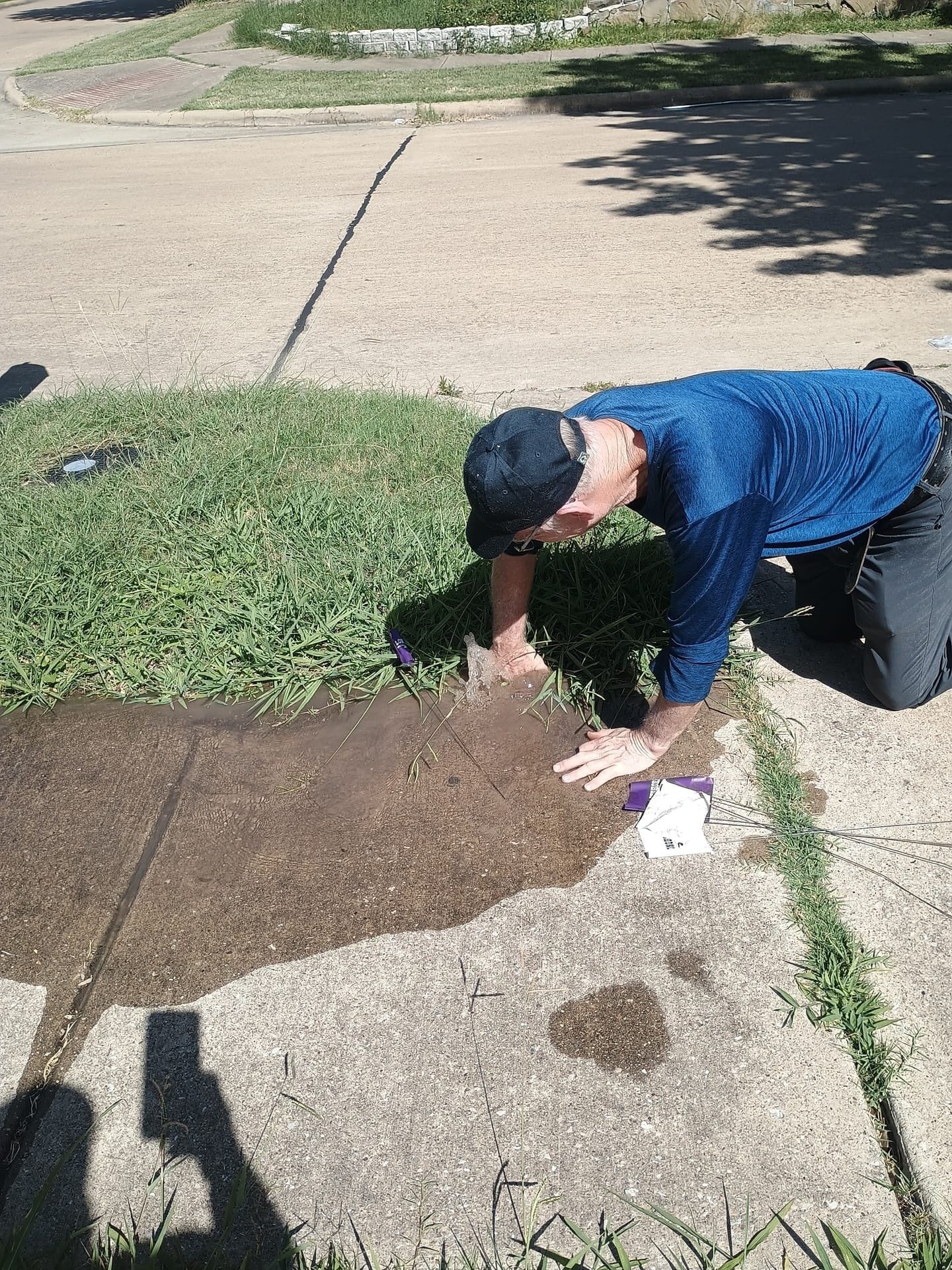
Old pipe and fittings: Galvanized pipe, polyethylene tubing, and discontinued fittings take more labor. Parts for discontinued brands sometimes need adapters or custom solutions.
Scope of damage: A single broken head is a quick fix. A fence install that cut wires and knocked out three zones is a bigger job. The number of components involved and whether the issue is isolated or system-wide drives the final number.
Heat stress on components: North Texas UV exposure combined with 100°+ temperatures accelerates plastic degradation. Sprinkler heads and valve covers often crack or become brittle after 5–7 years here, while the same components might last 10–15 years in milder climates.
3-Year Warranty on Every Repair
Every repair comes with a 3-year warranty on parts and labor. If anything we fixed fails within that window, we come back and make it right at no extra charge. If a manufacturer warranty extends beyond 3 years, we’ll swap the part under that warranty — but labor isn’t covered past our 3-year window.
We use commercial-grade parts from Hunter, Rain Bird, and Rachio — not the builder-grade components you find at big box stores. Better parts last longer and fail less, which means fewer callbacks for us and fewer headaches for you.
Why the Cheapest Quote Isn’t Always the Best Deal
You can find someone on Craigslist or Nextdoor who will fix a sprinkler head for less. But a lot of the people advertising irrigation repair in DFW are not licensed irrigators. Texas law requires a TCEQ license to install, maintain, alter, repair, or service an irrigation system. Working without one is illegal — and it means no regulatory oversight, no continuing education, and no accountability if something goes wrong.
Unlicensed operators typically don’t carry liability insurance either. If they hit a gas line, flood your yard, or cause a backflow contamination issue, you’re on the hook. They also tend to use the cheapest parts available — the same builder-grade heads and fittings that failed in the first place. You end up paying twice: once for the cheap fix, and again when it breaks six months later.
We carry full liability insurance, hold TCEQ License LI0023963, and use commercial-grade components on every job. The 3-year warranty backs it up.
How to Save Money on Sprinkler Repairs
Bundle repairs — if you have multiple issues, fix them all in one visit. You pay one trip instead of two or three.
Schedule during the off-season: Summer is peak season. Everyone’s watering their lawns, systems are running daily, and failures spike. If you can wait until late fall or winter for non-urgent repairs, demand is lower and availability is better.
Bundle repairs: If you have multiple issues, fix them all in one visit. You’ll save on trip costs and the technician can diagnose the entire system at once rather than piecemeal.
DIY the simple stuff: Replacing visible sprinkler heads, clearing clogged nozzles, and adjusting spray patterns are all homeowner-friendly tasks. See the section below for what you can handle yourself.
Invest in preventive maintenance: A $65 inspection catches small problems before they become expensive failures. It’s cheaper to swap a $55 sprinkler head during an inspection than to pay for an emergency pipe repair when the whole zone fails.
Consider a smart controller: If your controller is outdated, upgrading to a Rachio smart controller during repairs can reduce your water bill 30–50%, offsetting the repair costs within a year or two.
When to DIY vs. Hire a Professional
An honest breakdown of what you can tackle yourself and what needs a licensed irrigator.
DIY-Friendly Repairs
Replacing visible sprinkler heads: If you can see the head and access it easily, you can replace it. Most heads screw directly onto risers. Match the head type (spray vs. rotor) and arc pattern. Takes about 10 minutes once you have the right replacement part. Parts cost $5–$15 at any hardware store.
Adjusting spray patterns: Most heads have adjustment screws or slots. Turn clockwise to reduce arc, counterclockwise to increase. Free and takes two minutes. Proper adjustment can eliminate dry spots and reduce water waste.
Clearing clogged nozzles: Pull the nozzle filter, rinse under water, reinstall. Takes five minutes. Common in areas with hard water or when debris enters the system during repairs.
Basic timer programming: Most controllers have straightforward programming interfaces. Reading the manual helps. Or book an inspection — programming is included.
Always Hire a Professional
Buried valve repairs: You need valve locating equipment to find them and specialized tools to repair them. Trying to locate buried valves by trial-and-error digging can take hours and leave your yard looking like a minefield.
Underground pipe leaks: Proper excavation, pipe cutting, fitting installation, and pressure testing all require experience and equipment. A failed DIY pipe repair will leak underground, wasting thousands of gallons before you notice.
Electrical and wiring issues: Diagnosing irrigation wiring problems requires multimeters and systematic troubleshooting. Without a methodical approach, you can spend hours chasing the wrong problem.
Backflow preventer work: Backflow preventers protect the municipal water supply from contamination. Regulations are strict, and replacement needs to be done right.
Complex system diagnostics: If you can’t figure out why multiple zones are failing or pressure is inconsistent, professional diagnostic tools identify the root cause in 15–20 minutes. Trial-and-error can take days. Before calling for repairs, try our troubleshooting guide for systems that won’t turn on.
Questions to Ask Before Hiring a Contractor
Don’t just hire the first company you find.
“Are you a TCEQ licensed irrigator?” Texas law requires it. Ask for the license number and verify it. If they can’t provide one, walk away.
“Do you carry liability insurance?” This protects you if something goes wrong during the repair. Ask for proof and verify it’s current.
“Is the quote flat-rate or hourly?” Flat-rate means you know the cost before work starts. Hourly means the clock is running and you won’t know the final number until it’s done. Flat-rate is always better for the homeowner.
“What warranty do you provide?” Reputable companies warrant their work. Ask how long and what it covers. A 30-day warranty is bare minimum. A 3-year warranty means they stand behind their work.
“What parts do you use?” Commercial-grade parts (Hunter, Rain Bird) last significantly longer than builder-grade components from big box stores. If they’re using the cheapest parts available, you’ll be calling someone again in a year.
“Can you diagnose the problem before starting work?” Avoid contractors who start digging without a clear diagnosis. You should know what’s broken and what it’ll cost before work begins.
When to Repair vs. Replace Your Entire System
Sometimes it makes more sense to replace the whole system rather than keep fixing an old one.
Consider replacement if:
- Your system is 15+ years old and needs frequent repairs
- Repair costs exceed 50% of what a new system would cost
- You’re replacing multiple major components simultaneously
- Your system is inefficient and driving high water bills
A well-maintained system can last 30 to 40 years, so age alone doesn’t decide it. The 50% rule is a good guideline: if repairs will cost more than half of a new system, replacement is usually the smarter financial decision.
Stick with repairs if:
- Your system is less than 10 years old
- The repair is isolated to one or two components
- Total repair cost is under $500
- The rest of the system is functioning well
Every repair is quoted flat-rate before we start. You know exactly what it costs — no surprises, no running clock.
— Brandon Surratt, TCEQ Licensed Irrigator LI0023963Frequently Asked Questions
How much does it cost to fix a sprinkler head?
Sprinkler head replacement starts at $55 in DFW. The final price depends on the head type (pop-up spray, rotor, or specialty nozzle), whether the riser or swing pipe needs replacing, and how accessible the head is.
How much does sprinkler valve repair cost?
Valve repair starts at $150. A simple solenoid or diaphragm swap is on the lower end. Prices go up when roots have grown into the valve box, wiring is corroded, or the valve is buried and needs locating first.
What does flat-rate pricing mean?
It means you get a specific dollar amount before any work starts. No hourly clock, no surprise charges. If we dig in and find something unexpected that changes the scope, we bring you a revised estimate and explain what we found. You decide how to proceed.
Why are your prices different from what I see online?
Most pricing you find online comes from national directories that average costs across the entire country. A repair in rural Nebraska does not cost the same as one in DFW. Our prices reflect real DFW labor rates, local supply costs, and the specific soil and conditions we work in.
Is a smart controller worth the cost?
If your water bill is over $150 a month during summer, a Rachio smart controller usually pays for itself within one or two seasons through water savings alone. Installation starts at $500 and includes the controller, programming, and WiFi setup.
What affects the cost of a pipe repair?
Three things: depth, location, and how much pipe needs replacing. A shallow lateral line in an open yard is straightforward. A mainline under a sidewalk or driveway is a bigger job. Older systems with galvanized or polyethylene pipe take more labor than standard PVC.
Can I repair my sprinkler system myself?
Simple fixes like replacing visible sprinkler heads, clearing clogged nozzles, and adjusting spray patterns are DIY-friendly. But buried valve repairs, pipe leaks, and electrical issues require professional tools and expertise. If you can’t see the problem component, you probably can’t fix it yourself.
How do I know if I should repair or replace my irrigation system?
If repair costs exceed 50% of a new system’s cost, or if your system is 15+ years old with frequent issues, replacement usually makes more financial sense. For isolated repairs on systems less than 10 years old, repairs are the better choice.
The Bottom Line
Sprinkler repair in Dallas-Fort Worth costs more than the generic national averages suggest, but it doesn’t have to be a mystery. Flat-rate pricing means you know exactly what you’re paying before work starts. A 3-year warranty means you’re not paying again if something fails.
The biggest mistake homeowners make is hiring unlicensed operators to save $50. You get cheap parts, no warranty, no insurance, and a repair that lasts six months instead of six years. A TCEQ licensed irrigator using commercial-grade parts costs more upfront but saves you money in the long run.
If you’re in the DFW area dealing with sprinkler issues, we diagnose problems quickly and give you a flat-rate quote before any work begins. Schedule your sprinkler repair — we serve Garland, Plano, Richardson, and 12 other cities across the Metroplex.